Tiếng Việt
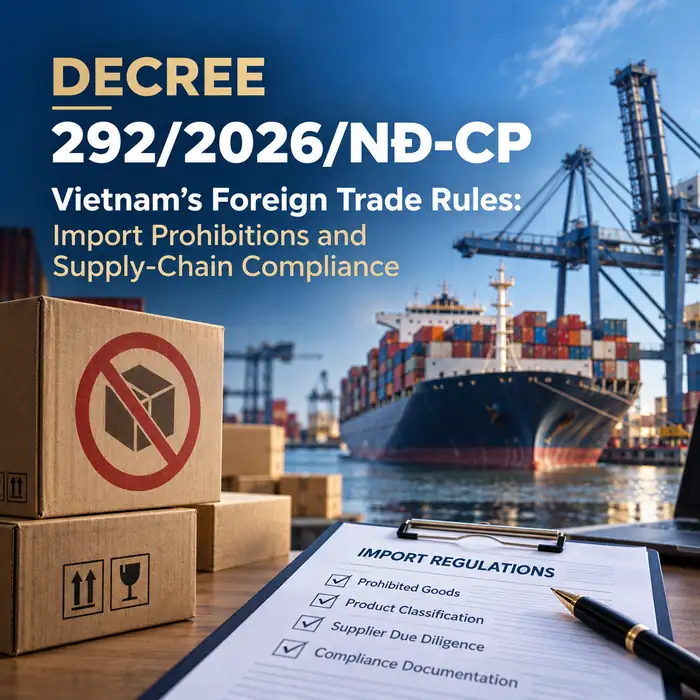
Vietnam’s Foreign Trade Rules: Import Prohibitions and Supply-Chain Compliance
Decree No. 292/2026/ND-CP, issued by the Vietnamese Government on July 22, 2026, and effective from September 5, 2026, provides detailed regulations and implementation measures for Vietnam’s Law on Foreign Trade Management. The decree establishes rules concerning prohibited imports and exports, including a prohibition on certain goods extracted, produced, or manufactured wholly or partly through forced labour.
For importers, manufacturers, foreign-invested enterprises (FIEs), and businesses operating international supply chains, Decree 292/2026/ND-CP is relevant to product classification, sourcing decisions, supplier screening, and import compliance. Businesses should assess whether their products fall within the prohibited goods lists and review the supporting documentation available for their supply chains.
Importantly, the prohibition on forced-labour-related goods should not automatically be interpreted as imposing one universal supplier-audit procedure on every importer. The applicable legal requirements, relevant international commitments, product characteristics, and sourcing circumstances must be assessed in context.
1. Overview of Decree 292/2026/ND-CP
Decree 292/2026/ND-CP provides detailed regulations and implementation measures for the Law on Foreign Trade Management, including the framework governing goods prohibited from export or import.
Under Article 5, prohibited imports and exports are determined by applicable legislation and the list in Appendix I to the decree. The decree also provides for competent ministries to publish detailed lists of prohibited goods with their corresponding Harmonized System (HS) codes, except where existing legislation already specifies those codes.
This distinction is important for businesses because a general product description alone may not be sufficient to determine whether a particular shipment is prohibited. Product specifications, classification, and the detailed applicable list must also be considered.
The decree took effect on September 5, 2026. Businesses should therefore review transactions and import arrangements falling within its applicable scope, particularly where product classification, sourcing, or import procedures may be affected.
Why does this matter to businesses?
The rules are relevant to several business functions:
-
Import and procurement: Assessing whether goods can legally enter Vietnam before placing orders or arranging shipment.
-
Manufacturing: Reviewing imported materials, components, and equipment used in production.
-
Supply-chain management: Identifying potential risks involving suppliers, subcontractors, and production locations.
-
Legal and compliance: Reviewing applicable prohibitions, licensing requirements, and supporting documents.
-
Foreign investment: Ensuring that import activities conducted by FIEs are consistent with Vietnam’s foreign trade regulations.
Businesses should review the decree together with relevant sector-specific legislation and implementing documents rather than relying exclusively on a general summary of prohibited goods.
2. Import and Export Prohibitions: How Businesses Should Identify Controlled or Prohibited Goods
2.1. Review the prohibited goods lists
Appendix I to Decree 292/2026/ND-CP contains lists of goods prohibited from export and import. The lists cover various categories, including weapons and ammunition, certain hazardous chemicals, electronic cigarettes and heated tobacco products, specified used goods, and other products subject to particular legal restrictions.
The import prohibition list also covers certain used consumer goods, used vehicles and equipment, used medical equipment, and used digital technology products, subject to the descriptions and applicable provisions.
These categories should not be treated as interchangeable. The exact scope depends on the wording of the relevant entry and any applicable exceptions or sector-specific regulations.
For example, a company importing used equipment should not assume that every used product is treated identically. It should identify the product category, examine the relevant list entry, and check whether the goods fall within the precise description of a prohibited item.
2.2. Confirm the applicable HS code and product description
Product classification is a key step in import compliance. Businesses should compare the product’s technical characteristics and intended use with the relevant classification and detailed list published by the competent authority.
A practical review should consider:
-
The product’s commercial name and technical specifications.
-
Its composition, function, condition, and intended use.
-
The proposed HS code and supporting classification information.
-
The applicable prohibited goods list and relevant sector-specific rules.
-
Any licensing, permit, or other regulatory requirements that may apply.
An HS code should not be selected solely because it appears on a supplier invoice or in a previous shipment record. If the classification is uncertain, the business should obtain appropriate technical and legal clarification before proceeding.
2.3. Distinguish prohibited goods from goods subject to other controls
Not every regulated product is necessarily prohibited from importation. Some goods may instead be subject to licensing, technical standards, specialized inspections, or other conditions under applicable legislation.
Article 5 of Decree 292/2026/ND-CP also addresses the circumstances and procedures under which permission may be granted for certain goods that are otherwise prohibited, pursuant to the relevant legal provisions.
The existence of such a procedure does not mean that a business can import a prohibited product simply by applying for a permit. Eligibility, competent authority, documentation, and the applicable legal basis must first be established.
Businesses should therefore distinguish between three questions:
-
Is the product prohibited from importation?
-
If it is not prohibited, does it require a licence or another form of regulatory approval?
-
If a specific legal exception may apply, what conditions and authorization procedures govern that exception?
Making these distinctions before shipment can help businesses avoid incorrect assumptions about import eligibility.
3. Forced-Labour-Related Import Prohibition and Supply-Chain Due Diligence
3.1. What does the decree prohibit?
A significant provision in Appendix I to Decree 292/2026/ND-CP concerns products and goods extracted, produced, or manufactured wholly or partly through forced labour.
The prohibition applies to goods from enterprises, countries, or territories in accordance with relevant international treaties to which Vietnam is a party.
This means that the assessment may extend beyond the final assembly stage. Depending on the circumstances, the origin of raw materials, intermediate goods, and manufacturing processes may also be relevant to identifying potential forced-labour-related risks.
Businesses should not assume that a product is compliant merely because its final manufacturing or assembly stage took place in a country where no concern has been identified. The relevant production and sourcing circumstances must be considered in light of the applicable legal framework.
3.2. Why supply-chain visibility matters
Businesses often purchase materials and components through multiple suppliers, subcontractors, and intermediaries. In these circumstances, the importer may not have direct visibility into every stage of production.
A supplier’s general declaration may provide useful information, but it may not, by itself, establish that every relevant production stage is free from forced labour.
Depending on the product and the risks identified, businesses may consider reviewing:
-
The identity and location of direct suppliers and relevant subcontractors.
-
Information about the origin of raw materials and intermediate products.
-
Available manufacturing records and production documentation.
-
Supplier declarations and relevant contractual commitments.
-
Credible reports, complaints, or other warning signs concerning labour practices.
These are practical risk-management measures, not a claim that Decree 292/2026/ND-CP prescribes every measure as a mandatory procedure for every importer.
The appropriate level of review should reflect the applicable legal requirements, the nature of the goods, the complexity of the supply chain, and the risks identified.
3.3. How should businesses respond to potential red flags?
Potential warning signs may include inconsistent supplier information, unexplained changes in sourcing locations, missing production records, or credible allegations of forced labour involving a supplier or production site.
When such issues arise, businesses should avoid treating an unsupported assurance as conclusive evidence of compliance.
A proportionate response may include requesting additional documentation, clarifying the production process, escalating the matter to legal or compliance personnel, and assessing whether the planned import should be delayed pending clarification.
Where the available information indicates a material legal risk, the business should obtain appropriate legal advice before proceeding with the transaction.
The objective is to identify and address relevant risks before goods are shipped or imported, rather than discovering a potential prohibition only after the goods reach the border.
4. Documentation and Supplier-Screening Considerations for Importers
4.1. Maintain accurate product records
Importers should maintain records sufficient to identify the goods and support the basis for their import compliance assessment.
Depending on the transaction, relevant documents may include:
-
Product specifications, catalogues, and technical descriptions.
-
Commercial invoices, packing lists, and transport documents.
-
Proposed HS codes and relevant classification records.
-
Applicable licences, permits, or regulatory approvals.
-
Supplier information and declarations concerning product origin or manufacturing.
These documents should be consistent with the actual goods being imported. Where a product description changes or a supplier substitutes materials or components, the business should reassess whether the original compliance analysis remains valid.
4.2. Review suppliers and sourcing arrangements
Supplier screening can help businesses identify risks that may not be apparent from the commercial documents alone.
For higher-risk products or supply chains, a company may consider reviewing the supplier’s identity, production locations, subcontracting arrangements, sourcing records, and available information about labour practices.
Contractual arrangements may also help establish responsibilities for providing accurate product information, maintaining relevant records, notifying the buyer of material sourcing changes, and cooperating with reasonable compliance inquiries.
The suitability of these measures depends on the transaction and applicable law. Contractual assurances do not automatically eliminate statutory obligations or establish compliance where contrary evidence exists.
4.3. Establish an internal escalation process
Businesses should identify who is responsible for reviewing product classification, supplier information, and import restrictions.
An internal process may involve procurement, logistics, legal, compliance, and relevant technical teams. Each function should understand when a shipment requires further review and who has authority to resolve an identified issue.
Where product classification is uncertain, a supplier’s records are incomplete, or a potential forced-labour concern arises, the business should document the issue and the basis for its decision.
A clear escalation process can reduce the risk of commercial teams proceeding with an import before material compliance questions have been resolved.
5. Compliance Checklist: What Importers Should Review
Businesses importing goods into Vietnam can use the following checklist as a starting point for reviewing the implications of Decree 292/2026/ND-CP.
Step 1 — Verify the product classification. Confirm the product’s characteristics, proposed HS code, and relevant description under the applicable prohibited goods lists.
Step 2 — Check the applicable restrictions. Review Appendix I to Decree 292/2026/ND-CP and other relevant legislation to determine whether the goods are prohibited, conditionally permitted, or subject to licensing and other requirements.
Step 3 — Review supplier and sourcing information. Identify relevant suppliers, subcontractors, production locations, and available records concerning the goods’ manufacture and sourcing.
Step 4 — Assess forced-labour-related risks. Consider credible warning signs and determine whether additional information or legal review is necessary before proceeding.
Step 5 — Verify supporting documentation. Ensure that commercial documents, technical descriptions, classification information, supplier declarations, and applicable authorizations are accurate and consistent.
Step 6 — Escalate unresolved issues. Where the product classification, legality of importation, or sourcing circumstances remain uncertain, refer the matter to the appropriate compliance or legal personnel before shipment or importation.
Step 7 — Retain the review record. Keep relevant documents and record the basis for the company’s compliance assessment, subject to applicable record-retention requirements.
This checklist is a practical management tool. It should be adapted to the business’s products, supply chain, transaction structure, and applicable legal obligations.
6. What Foreign-Invested Enterprises Should Consider
Foreign-invested enterprises operating in Vietnam may import raw materials, machinery, components, finished products, and goods for distribution. Depending on their business activities, they may therefore need to review both product-specific restrictions and the wider legal framework governing their import operations.
FIEs should consider whether their procurement arrangements provide sufficient visibility into the goods being imported, whether product classification has been reviewed against current requirements, and whether the company can obtain supporting information from overseas suppliers.
For multinational groups, a supplier assessment or product classification prepared for another market should not automatically be assumed to satisfy Vietnamese requirements. The applicable Vietnamese prohibited goods lists, licensing framework, and relevant sector-specific legislation should be reviewed separately.
Businesses should also distinguish legal compliance from broader internal responsible-sourcing policies. A company may choose to implement more extensive supplier standards as part of its global governance framework, but such policies should not be confused with a specific statutory procedure unless the applicable law establishes one.
Where a company faces uncertainty about a prohibited goods entry, a potential forced-labour issue, or the legal basis for importing a particular product, an entity-specific review may help clarify the applicable requirements before the transaction proceeds.
7. LTS LAW Perspective: Turning Regulatory Requirements into Practical Controls
Decree 292/2026/ND-CP highlights the importance of identifying prohibited goods and understanding how product restrictions may affect international sourcing and import operations.
LTS LAW recommends that businesses approach import compliance as a structured review rather than relying solely on a supplier’s description or the existence of previous shipments.
The review should begin with the actual product and its proposed classification, followed by an assessment of the relevant legal restrictions and any applicable authorization requirements. Where forced-labour-related concerns arise, businesses should examine the available sourcing information and determine whether further clarification or legal review is necessary.
For businesses with complex supply chains, multiple suppliers, or foreign-invested operations, the review may also involve examining commercial contracts, information-sharing arrangements, and internal escalation procedures.
The appropriate approach depends on the goods, transaction, and applicable legislation. Businesses should avoid assuming that one general supplier declaration or a single standardized checklist will resolve every legal risk.
By reviewing product classification, supplier information, supporting documents, and relevant legal requirements before shipment, businesses can make better-informed decisions about import eligibility and reduce the risk of proceeding with a transaction that may be prohibited.
Disclaimer
This article refers to Decree No. 292/2026/ND-CP, particularly Article 5 and Appendix I concerning prohibited imports and exports. Businesses should consult the official Vietnamese text and applicable implementing regulations when determining whether specific goods may be imported into Vietnam.
The practical measures discussed in this article are general compliance considerations and should not be interpreted as a statement that every measure constitutes a specific statutory obligation for every importer. Businesses should review the full legal text, relevant product lists, applicable international commitments, and any sector-specific rules before making import or sourcing decisions.
For advice tailored to your specific circumstances, please contact LTS LAW FIRM for further consultation and legal assistance.
LTS LAW FIRM
Floor 6, 520 Cach Mang Thang Tam
Nhieu Loc Ward, Ho Chi Minh City, Vietnam
Tel: (+84) 965 000 524
Email: contact@lts.com.vn
Working hours: Monday – Friday, 8 AM – 6 PM VNT