Tiếng Việt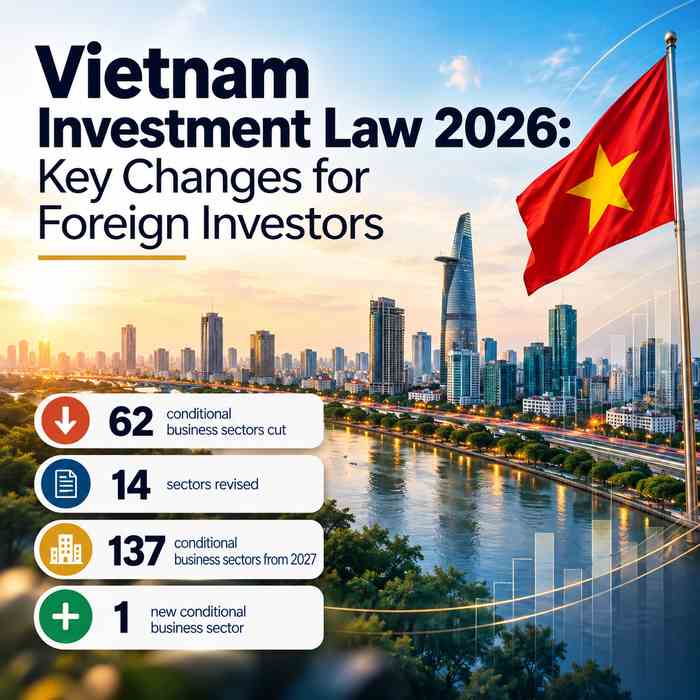
Vietnam Investment Law 2026: Key Changes for Foreign Investors
Vietnam is set to introduce important changes to its investment and business regulatory framework in 2027.
On 24 August 2026, Vietnam promulgated Law No. 24/2026/QH16 amending and supplementing a number of provisions of the Law on Investment (“Investment Law 2026”). The Law will generally take effect from 1 March 2027.
One of the most significant changes is the restructuring of Vietnam’s list of conditional business sectors. The new Law cuts 62 conditional business sectors and revises 14 others, reducing the new list to 137 conditional business sectors.
For foreign investors, these changes may be relevant when planning a new investment, reviewing an existing business structure or assessing market-entry requirements in Vietnam.
What Is Vietnam Investment Law 2026?
Law No. 24/2026/QH16 replaces the existing list of conditional business sectors under Appendix IV of the 2025 Law on Investment with a new list.
The reform follows a broader policy direction of simplifying investment and business regulations and moving, where appropriate, from pre-inspection toward post-inspection. The objective is to remove unnecessary conditions while maintaining effective regulatory oversight in sectors involving significant risks, including national security, public order, public safety and public health.
The Government estimates that the reform could:
-
Cut approximately 786 business conditions;
-
Reduce approximately 232 administrative procedures;
-
Reduce compliance costs by approximately VND 175 billion per year; and
-
Reduce compliance time by approximately 7,500 hours per year.
For businesses and investors, the changes are therefore broader than simply reducing the number of conditional business sectors.
Key Changes Under Vietnam Investment Law 2026
The main changes can be summarized as follows:
| Key change | Details |
|---|---|
| Conditional business sectors | 62 sectors cut and 14 sectors revised |
| New list | 137 conditional business sectors from 1 March 2027 |
| New conditional sector | Visa support services provided by authorized business establishments |
| Business conditions | Approximately 786 conditions expected to be reduced |
| Administrative procedures | Approximately 232 procedures expected to be reduced |
| Compliance costs | Expected reduction of approximately VND 175 billion per year |
| Compliance time | Expected reduction of approximately 7,500 hours per year |
| Regulatory approach | Greater shift from pre-inspection toward post-inspection |
Vietnam Cuts 62 Conditional Business Sectors
The 62-sector reduction is one of the headline changes under the new Investment Law.
However, the figure should not be read as meaning that 62 business activities have simply been deleted one by one.
The reduction reflects a broader restructuring of the conditional business sector framework, including the removal, consolidation and adjustment of existing sectors.
For example, several education activities that previously appeared as separate sectors are consolidated into a broader education-related sector. Activities involving unmanned aircraft are also reorganized into broader categories.
This distinction matters because the legal effect of removing a sector entirely is different from consolidating several existing sectors or narrowing the scope of a conditional activity.
Business Sectors Removed from the Conditional List
The following sectors are identified in the detailed comparison as being removed from the conditional business list:
| No. | Business sector |
|---|---|
| 1 | Paintball gun business |
| 2 | Business of signaling equipment for priority vehicles |
| 3 | Auction practice |
| 4 | Bailiff practice |
| 5 | Asset management and liquidation practice in bankruptcy proceedings |
| 6 | Accounting services |
| 7 | Duty-free goods business |
| 8 | Gas business |
| 9 | Alcohol business |
| 10 | Mineral trading |
| 11 | Trading activities and activities directly related to trading activities of foreign service suppliers in Vietnam |
| 12 | Oil and gas activities |
| 13 | Vocational education quality assessment |
| 14 | Occupational safety and hygiene training services |
| 15 | Training services for road traffic safety assessment personnel |
| 16 | Inland waterway transportation |
| 17 | Maritime transportation |
| 18 | Import and demolition of used seagoing ships |
| 19 | Seaport operation |
| 20 | Pipeline transportation |
| 21 | Clean water supply |
| 22 | Construction inspection practice |
| 23 | Business of white asbestos products of the Serpentine group |
| 24 | Publishing services |
| 25 | Information content services on mobile telecommunications networks and the Internet |
| 26 | Domain name registration and maintenance services |
| 27 | Operation of specialized schools |
| 28 | Foreign-linked training activities |
| 29 | Educational quality accreditation |
| 30 | Testing services for aquatic and animal feed and environmental treatment products |
| 31 | Business of biological preparations, microorganisms, chemicals and environmental treatment products in animal husbandry |
| 32 | Construction and conversion of fishing vessels |
| 33 | Training and professional development of fishing vessel crew |
| 34 | Plant protection services |
| 35 | Veterinary technical services |
| 36 | Testing services for plant and animal varieties |
| 37 | Testing services for aquatic breeds |
| 38 | Testing and assessment services for biological preparations, microorganisms, chemicals and environmental treatment products in aquaculture and animal husbandry |
| 39 | Business of insecticides and disinfectants for household and medical use |
| 40 | Intellectual property assessment services |
| 41 | Business of audio and video recordings of music and stage performances |
| 42 | Museum services |
| 43 | Electronic game business, except specified prize-winning electronic games |
| 44 | Land investigation and assessment consultancy services |
| 45 | Land-use planning and planning consultancy services |
| 46 | Land price determination services |
| 47 | Decision-support services for water resource allocation and reservoir/inter-reservoir operation |
| 48 | Foreign exchange business and supply of foreign exchange services by non-credit institutions |
| 49 | Training and certification of radio operators |
These are the sectors identified as being removed from the conditional list. The broader 62-sector reduction also reflects restructuring and other changes to the previous framework.
Consolidation and Restructuring of Existing Business Sectors
The reform also changes how certain activities are classified.
Education
Several education-related activities that were previously listed separately are consolidated into one broader sector covering:
Preschool education, general education, higher education and continuing education activities.
This means the new framework is not simply a list of deleted sectors. It also reduces fragmentation within the conditional business sector framework.
Unmanned Aircraft
Activities relating to unmanned aircraft are also reorganized.
Previously separate activities such as import, temporary import for re-export, temporary export for re-import, research, manufacturing, testing, repair and maintenance are brought under a broader business-sector description.
This approach reduces the number of separate entries while retaining regulatory controls over the relevant activities.
Customs-Related Activities
The wording of certain customs-related business activities is also narrowed.
For example, the new list refers to:
Business of locations for customs clearance, collection, inspection and customs supervision
with the wording adjusted under the new framework.
These examples illustrate why the 62-sector reduction should be understood as a structural reform of the list, rather than simply the deletion of 62 individual business lines.
A New Conditional Business Sector Is Added
The reform is not entirely about removing business conditions.
Law No. 24/2026/QH16 adds “visa support services provided by authorized business establishments” as a new conditional business sector, listed as No. 137 in the new list.
According to the Government, the additional condition is intended to strengthen oversight of activities involving immigration, national security and personal data risks.
The overall direction is therefore to remove conditions where they are no longer necessary while maintaining or strengthening controls in higher-risk areas.
What Does This Mean for Foreign Investors?
The changes may create more flexibility for businesses in affected sectors. However, foreign investors should distinguish between conditional business sectors and foreign market access conditions.
These are separate regulatory questions.
Conditional Business Sectors
A conditional business sector is an activity for which Vietnamese law requires the investor or business to satisfy specific conditions.
If the activity is removed from the conditional list, those conditions no longer apply solely because the activity was previously classified as conditional.
Foreign Market Access Conditions
Foreign investors must separately assess whether their proposed business activities are subject to foreign market access conditions.
Depending on the sector, these conditions may concern:
-
Foreign ownership ratios;
-
Forms of investment;
-
Scope of investment activities;
-
Vietnamese partners; or
-
Other requirements under Vietnamese law or applicable international commitments.
Therefore, the removal of a business sector from the conditional list does not automatically mean that foreign investors can enter that sector without restrictions.
Sector-Specific Requirements
Other laws may continue to regulate the same activity.
For example, an activity may no longer be a conditional business sector under the Investment Law while still being subject to sector-specific licences, professional requirements, technical standards or other regulatory obligations.
For this reason, foreign investors should assess the Investment Law together with the regulations applicable to their particular business activity.
What About the Investment Registration Certificate?
The reduction of conditional business sectors should not be interpreted as an automatic change to every Investment Registration Certificate (IRC) requirement.
Whether an IRC is required, and what requirements apply to an investment project, depends on the specific project, investor and proposed activities.
For a foreign investor, the regulatory assessment may therefore involve:
Business activities → Foreign market access → Investment structure → IRC requirements → ERC requirements → Sector-specific licences → Ongoing compliance
The upcoming changes may affect one or more of these stages depending on the nature of the investment.
Transitional Rules for Existing Businesses
The Law also provides transitional rules for sectors that are no longer classified as conditional.
From the effective date, organizations and individuals may conduct investment and business activities in those sectors without having to satisfy the former business conditions.
Where an existing licence, certificate, professional certificate, confirmation or other relevant approval has already been issued, the holder may, if desired, continue using it until its expiry without having to apply for a new issuance, adjustment or extension solely because the relevant sector is no longer conditional.
For valid applications that were received before the new Law takes effect but have not yet been processed, the competent authority will handle them in accordance with the transitional provisions of the Law.
This is particularly relevant for businesses that are already operating or are currently preparing licensing applications.
What Should Foreign Investors Do Before 1 March 2027?
For investors planning to enter or expand in Vietnam in 2027, the period before the new Law takes effect provides an opportunity to review the proposed investment structure and business activities.
1. Review the proposed business activities
Identify the actual activities that the Vietnam entity will conduct.
The regulatory assessment should be based on the substance of the business rather than only a general description of the company’s operations.
2. Check the new conditional business list
Compare the proposed activities against the new framework applicable from 1 March 2027.
Where an activity has been removed, consolidated or restructured, investors should assess the practical effect on their planned operations.
3. Check foreign market access conditions separately
The removal of a business condition does not necessarily remove restrictions applicable specifically to foreign investors.
Foreign ownership, investment forms and other market access conditions should therefore be reviewed independently.
4. Review the investment structure
For new FDI projects, investors may wish to review:
-
Proposed ownership structure;
-
Investment form;
-
Business lines;
-
Investment capital;
-
Project objectives; and
-
Licensing strategy.
5. Consider the timing of market entry
For projects currently under preparation, the 1 March 2027 effective date may be relevant when deciding when to submit applications or commence certain activities.
The appropriate approach will depend on the specific project and applicable transitional provisions.
Why This Matters for Investors Planning for 2027
The significance of the Investment Law 2026 goes beyond the headline number of 62 sectors.
For foreign investors, the more practical question is:
How will the amended framework affect the specific activities and structure of my Vietnam investment?
An investor planning a new project may need to determine whether the changes affect its proposed business lines, market access conditions or licensing strategy.
An existing foreign-invested company may also benefit from reviewing whether any of its current activities are affected by the revised framework.
This makes the Investment Law 2026 particularly relevant for investors currently preparing Vietnam market-entry and expansion plans for 2027 and beyond.
LTS Perspective
At LTS, we see the practical significance of the Investment Law 2026 not simply in the number of sectors removed or revised, but in how these changes may affect an investor’s overall market-entry strategy.
For foreign investors preparing to enter or expand in Vietnam, reviewing proposed business activities, foreign market access conditions and licensing requirements before March 2027 can help identify potential regulatory changes at an early stage.
For projects being planned for 2027, this early review may also support better-informed decisions on investment structure, licensing strategy and implementation timeline.
Conclusion
Law No. 24/2026/QH16 represents a significant step in Vietnam’s continuing effort to simplify its investment and business regulatory framework.
From 1 March 2027, the amendments will reduce and restructure the list of conditional business sectors, while revising other regulated activities and introducing new requirements in selected areas.
For foreign investors, the key takeaway is that the reduction of business conditions does not mean that all market-entry requirements disappear. Foreign market access, investment registration and sector-specific regulations should still be assessed alongside the new framework.
For investors planning a new project or business expansion in Vietnam in 2027, understanding these changes early can provide a clearer basis for planning the appropriate market-entry structure and compliance strategy.
Disclaimer
This article is provided for general informational and reference purposes only and does not constitute legal advice. The application of relevant laws and procedures may vary depending on the specific documents, circumstances, and countries or territories involved.
For advice tailored to your specific circumstances, please contact LTS LAW FIRM for further consultation and legal assistance.
LTS LAW FIRM
Floor 6, 520 Cach Mang Thang Tam
Nhieu Loc Ward, Ho Chi Minh City, Vietnam
Tel: (+84) 965 000 524
Email: contact@lts.com.vn
Working hours: Monday – Friday, 8 AM – 6 PM VNT