Tiếng Việt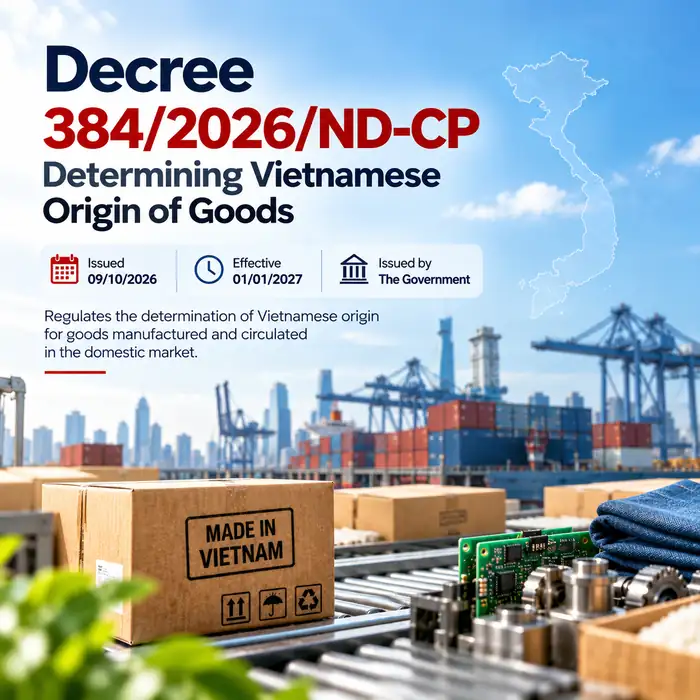
Decree 384/2026/ND-CP: New Rules on Determining Vietnamese Origin of Goods
Effective date: January 1, 2027
Vietnam has introduced a new legal framework for determining Vietnamese origin for goods manufactured and circulated in the domestic market. Government Decree No. 384/2026/ND-CP, issued on October 9, 2026, establishes criteria for identifying goods of Vietnamese origin, including wholly Vietnamese-origin goods and goods that acquire Vietnamese origin through production involving non-originating materials.
The Decree is particularly relevant to manufacturers, traders, distributors, and businesses that identify products as Vietnamese-origin goods on labels or in related commercial information. Companies should review their sourcing, manufacturing, and product documentation before the new rules take effect on January 1, 2027.
1. What Is Decree 384/2026/ND-CP?
Official reference: Decree No. 384/2026/ND-CP on the Government’s legal document portal.
Decree No. 384/2026/ND-CP (the “Decree”) regulates the determination of Vietnamese origin for goods manufactured and circulated in Vietnam. It was issued by the Government on October 9, 2026, and will take effect on January 1, 2027.
The Decree consists of 12 articles addressing several key matters, including:
-
Goods originating from Vietnam.
-
Wholly Vietnamese-origin goods.
-
Non-wholly Vietnamese-origin goods.
-
Simple processing and manufacturing operations.
-
Factors excluded from origin determination.
-
Responsibilities of relevant authorities, organizations, and individuals.
The framework distinguishes between goods that originate wholly in Vietnam and goods that qualify through specified origin criteria despite involving non-originating materials.
The Decree also allows ministries and ministerial-level agencies, where necessary, to establish specific rules for products with distinctive characteristics within their respective areas of management, provided that those rules are consistent with the Decree.
2. Which Goods Qualify as Vietnamese-Origin Goods?
Under Article 4, goods qualify as Vietnamese-origin goods if they fall into either of two categories:
-
Wholly Vietnamese-origin goods under Article 5.
-
Non-wholly Vietnamese-origin goods under Article 6.
This distinction is important for businesses that manufacture products using domestic and imported materials. The location where a product is assembled or processed is not, by itself, sufficient to establish Vietnamese origin. Businesses must assess the applicable criteria and retain evidence supporting their conclusions.
2.1. Wholly Vietnamese-Origin Goods
Article 5 identifies categories of goods considered wholly Vietnamese-origin. These include:
-
Plants and plant products grown and harvested in Vietnam.
-
Animals born or raised in Vietnam and products obtained from those animals.
-
Products obtained through hunting, trapping, fishing, aquaculture, gathering, or capturing in Vietnam.
-
Minerals and naturally occurring substances extracted or taken from Vietnamese soil, water, seabed, or subsoil.
-
Products obtained from waters, seabed, or subsoil beyond Vietnam’s territorial sea where Vietnam has exploitation rights under international law.
-
Fish and other marine products caught on the high seas by vessels registered in Vietnam and authorized to fly the Vietnamese flag.
-
Products processed or produced aboard such vessels from the qualifying marine products.
-
Articles obtained from production or consumption in Vietnam that can no longer perform their original function, cannot be repaired or restored, and can only be discarded or used as raw materials or for recycling.
-
Goods obtained or produced from the categories listed above.
These categories cover agricultural products, animal products, minerals, marine products, recyclable materials, and goods derived from qualifying wholly originating products.
For businesses handling agricultural, seafood, mineral, or recycled-material products, the relevant category should be identified before making an origin claim. Supporting records should be consistent with the actual source and production history of the goods.
2.2. Non-Wholly Vietnamese-Origin Goods
Article 6 provides criteria under which goods involving non-originating materials may qualify as Vietnamese-origin goods.
The Decree identifies the following routes:
Change in tariff classification
Goods may qualify through a change in tariff classification, subject to the applicable requirements under the Decree. Businesses should review the classification of the relevant inputs and finished products rather than assume that any processing operation automatically satisfies this criterion.
Vietnam Value Content of at least 30%
Goods may also qualify where their Vietnam Value Content (VVC) reaches at least 30%, calculated using one of the two formulas provided in Article 6.
The direct formula is:
VVC = (Value of originating materials / Ex-factory price) × 100%
The indirect formula is:
VVC = [(Ex-factory price − Value of non-originating materials) / Ex-factory price] × 100%
Traders may choose either formula and apply it during the financial year.
The choice of formula should be supported by reliable production-cost and material-value records. Businesses should also ensure that the values used in the calculation are consistent with the applicable requirements and their underlying accounting documentation.
Packaging and containers
The value of packaging materials and containers that form an integral part of the goods is included in the VVC calculation. Businesses should therefore assess how their packaging is treated when calculating the originating content of a product.
Information technology and digital technology goods
For goods in the information technology and digital technology sectors, the VVC calculation includes certain value-creating activities performed in Vietnam. These activities include research and development, design, programming, digitalization, automation, technical testing, and software testing associated with the product creation process.
Article 6 also provides that the simple processing and manufacturing operations specified in Clause 2 of Article 7, and the factors excluded from origin determination under Article 8, do not apply to this specific VVC provision.
Businesses operating in technology-related sectors should therefore review the relevant activities and supporting cost records when assessing Vietnamese origin.
3. Which Factors Are Excluded from Origin Determination?
Article 8 specifies that certain factors used during production, inspection, or testing are not considered when determining Vietnamese origin if they do not constitute the goods themselves. The exclusion also covers certain factors used to maintain factory premises or operate equipment associated with production.
The listed factors include:
-
Fuel and energy.
-
Tools, dies, and moulds.
-
Spare parts and materials used to maintain equipment and factory premises.
-
Lubricants, greases, compounds, and other materials used in production or to operate equipment and factory premises.
-
Gloves, glasses, footwear, clothing, and safety equipment.
-
Equipment, tools, and machinery used to inspect or test goods.
-
Catalysts and solvents.
-
Other materials that do not constitute the goods, where their use is demonstrated to be necessary for the production process.
This distinction matters when a company assesses the materials and inputs relevant to origin determination. Not every item used in a factory necessarily forms part of the product or affects its origin calculation.
Businesses should maintain sufficiently detailed production records to distinguish product materials from operating supplies and other excluded factors. Where an exclusion depends on demonstrating that an input is necessary for production, appropriate supporting documentation may be important.
4. What Should Businesses Do Before January 1, 2027?
Although Decree 384/2026/ND-CP will not take effect until January 1, 2027, businesses that make Vietnamese-origin claims should begin reviewing their existing practices in advance.
Review product origin classifications
Identify products marketed or labelled as Vietnamese-origin goods. Determine whether each product falls within the wholly originating categories under Article 5 or must be assessed under the non-wholly originating criteria in Article 6.
Review materials and suppliers
Map the materials used in production, including their origins and values. For products assessed through a change in tariff classification, review the classification of inputs and finished goods. For products assessed through VVC, establish a reliable method for collecting and verifying the relevant values.
Check production and accounting records
Review bills of materials, supplier documentation, production records, cost data, and ex-factory pricing information. These records can help substantiate the basis for an origin determination and identify gaps before the effective date.
For technology products, businesses should also examine how eligible research, development, design, programming, and testing activities performed in Vietnam are documented.
Review product labels and commercial information
The Government’s explanation of the Decree refers to traders, organizations, and individuals expressing Vietnamese origin on product labels or on documents and materials containing information related to goods.
Businesses should review relevant labels and product-related information to ensure that origin claims are supported by the applicable criteria. Marketing descriptions should not be treated as a substitute for a legally supportable origin assessment.
Establish internal review procedures
Consider assigning responsibility for origin determinations across procurement, manufacturing, accounting, legal, and marketing teams. A consistent review process can help ensure that material sourcing, production data, calculations, and public-facing product claims remain aligned.
5. Why Decree 384/2026/ND-CP Matters to Manufacturers and Traders
The Decree provides a structured basis for determining Vietnamese origin for goods produced and circulated domestically. Its practical significance varies depending on the nature of the product, the sourcing model, and the manufacturing process.
For manufacturers using imported materials, the change-in-tariff-classification and VVC criteria may be particularly relevant. Companies relying on agricultural, mineral, seafood, or recycled inputs should assess whether their products fall within the wholly originating categories.
Businesses in the information technology and digital technology sectors should pay particular attention to the specific treatment of value-creating activities performed in Vietnam.
The Decree also makes documentation an important practical consideration. An origin claim should be supported by evidence consistent with the relevant criterion, rather than based solely on the location of final assembly, the nationality of the seller, or the wording used in promotional materials.
However, the Decree should not be interpreted as automatically determining eligibility for every preferential tariff, certificate of origin, or origin-related treatment under Vietnam’s international trade agreements. Those matters may be governed by separate rules and requirements. Businesses should assess the applicable legal framework for the specific transaction and purpose.
6. How LTS LAW Can Assist Businesses
Businesses preparing for the implementation of Decree 384/2026/ND-CP may need to review their product-origin claims, manufacturing arrangements, supplier documentation, and internal compliance procedures.
LTS LAW can assist businesses in reviewing relevant legal requirements, identifying potential issues in product-origin assessments, and evaluating the legal implications of sourcing and manufacturing arrangements in Vietnam.
Depending on the circumstances, legal support may include reviewing relevant documentation, assessing the applicable origin criteria, and advising on practical steps to improve the consistency of origin-related records and commercial representations.
Businesses should seek advice based on their actual products, production processes, materials, and intended use of origin claims. A product-specific assessment is preferable to relying on general assumptions about where a product is manufactured.
Disclaimer
This article provides general information based on Decree No. 384/2026/ND-CP and official Government publications. It does not constitute legal advice. Businesses should review the full legal text and any applicable sector-specific rules before making product-origin determinations.
For advice tailored to your specific circumstances, please contact LTS LAW FIRM for further consultation and legal assistance.
LTS LAW FIRM
Floor 6, 520 Cach Mang Thang Tam
Nhieu Loc Ward, Ho Chi Minh City, Vietnam
Tel: (+84) 965 000 524
Email: contact@lts.com.vn
Working hours: Monday – Friday, 8 AM – 6 PM VNT
Decree 384/2026/ND-CP: New Rules on Determining Vietnamese Origin of Goods
Effective date: January 1, 2027
Vietnam has introduced a new legal framework for determining Vietnamese origin for goods manufactured and circulated in the domestic market. Government Decree No. 384/2026/ND-CP, issued on October 9, 2026, establishes criteria for identifying goods of Vietnamese origin, including wholly Vietnamese-origin goods and goods that acquire Vietnamese origin through production involving non-originating materials.
The Decree is particularly relevant to manufacturers, traders, distributors, and businesses that identify products as Vietnamese-origin goods on labels or in related commercial information. Companies should review their sourcing, manufacturing, and product documentation before the new rules take effect on January 1, 2027.
1. What Is Decree 384/2026/ND-CP?
Official reference: Decree No. 384/2026/ND-CP on the Government’s legal document portal.
Decree No. 384/2026/ND-CP (the “Decree”) regulates the determination of Vietnamese origin for goods manufactured and circulated in Vietnam. It was issued by the Government on October 9, 2026, and will take effect on January 1, 2027.
The Decree consists of 12 articles addressing several key matters, including:
-
Goods originating from Vietnam.
-
Wholly Vietnamese-origin goods.
-
Non-wholly Vietnamese-origin goods.
-
Simple processing and manufacturing operations.
-
Factors excluded from origin determination.
-
Responsibilities of relevant authorities, organizations, and individuals.
The framework distinguishes between goods that originate wholly in Vietnam and goods that qualify through specified origin criteria despite involving non-originating materials.
The Decree also allows ministries and ministerial-level agencies, where necessary, to establish specific rules for products with distinctive characteristics within their respective areas of management, provided that those rules are consistent with the Decree.
2. Which Goods Qualify as Vietnamese-Origin Goods?
Under Article 4, goods qualify as Vietnamese-origin goods if they fall into either of two categories:
-
Wholly Vietnamese-origin goods under Article 5.
-
Non-wholly Vietnamese-origin goods under Article 6.
This distinction is important for businesses that manufacture products using domestic and imported materials. The location where a product is assembled or processed is not, by itself, sufficient to establish Vietnamese origin. Businesses must assess the applicable criteria and retain evidence supporting their conclusions.
2.1. Wholly Vietnamese-Origin Goods
Article 5 identifies categories of goods considered wholly Vietnamese-origin. These include:
-
Plants and plant products grown and harvested in Vietnam.
-
Animals born or raised in Vietnam and products obtained from those animals.
-
Products obtained through hunting, trapping, fishing, aquaculture, gathering, or capturing in Vietnam.
-
Minerals and naturally occurring substances extracted or taken from Vietnamese soil, water, seabed, or subsoil.
-
Products obtained from waters, seabed, or subsoil beyond Vietnam’s territorial sea where Vietnam has exploitation rights under international law.
-
Fish and other marine products caught on the high seas by vessels registered in Vietnam and authorized to fly the Vietnamese flag.
-
Products processed or produced aboard such vessels from the qualifying marine products.
-
Articles obtained from production or consumption in Vietnam that can no longer perform their original function, cannot be repaired or restored, and can only be discarded or used as raw materials or for recycling.
-
Goods obtained or produced from the categories listed above.
These categories cover agricultural products, animal products, minerals, marine products, recyclable materials, and goods derived from qualifying wholly originating products.
For businesses handling agricultural, seafood, mineral, or recycled-material products, the relevant category should be identified before making an origin claim. Supporting records should be consistent with the actual source and production history of the goods.
2.2. Non-Wholly Vietnamese-Origin Goods
Article 6 provides criteria under which goods involving non-originating materials may qualify as Vietnamese-origin goods.
The Decree identifies the following routes:
Change in tariff classification
Goods may qualify through a change in tariff classification, subject to the applicable requirements under the Decree. Businesses should review the classification of the relevant inputs and finished products rather than assume that any processing operation automatically satisfies this criterion.
Vietnam Value Content of at least 30%
Goods may also qualify where their Vietnam Value Content (VVC) reaches at least 30%, calculated using one of the two formulas provided in Article 6.
The direct formula is:
VVC = (Value of originating materials / Ex-factory price) × 100%
The indirect formula is:
VVC = [(Ex-factory price − Value of non-originating materials) / Ex-factory price] × 100%
Traders may choose either formula and apply it during the financial year.
The choice of formula should be supported by reliable production-cost and material-value records. Businesses should also ensure that the values used in the calculation are consistent with the applicable requirements and their underlying accounting documentation.
Packaging and containers
The value of packaging materials and containers that form an integral part of the goods is included in the VVC calculation. Businesses should therefore assess how their packaging is treated when calculating the originating content of a product.
Information technology and digital technology goods
For goods in the information technology and digital technology sectors, the VVC calculation includes certain value-creating activities performed in Vietnam. These activities include research and development, design, programming, digitalization, automation, technical testing, and software testing associated with the product creation process.
Article 6 also provides that the simple processing and manufacturing operations specified in Clause 2 of Article 7, and the factors excluded from origin determination under Article 8, do not apply to this specific VVC provision.
Businesses operating in technology-related sectors should therefore review the relevant activities and supporting cost records when assessing Vietnamese origin.
3. Which Factors Are Excluded from Origin Determination?
Article 8 specifies that certain factors used during production, inspection, or testing are not considered when determining Vietnamese origin if they do not constitute the goods themselves. The exclusion also covers certain factors used to maintain factory premises or operate equipment associated with production.
The listed factors include:
-
Fuel and energy.
-
Tools, dies, and moulds.
-
Spare parts and materials used to maintain equipment and factory premises.
-
Lubricants, greases, compounds, and other materials used in production or to operate equipment and factory premises.
-
Gloves, glasses, footwear, clothing, and safety equipment.
-
Equipment, tools, and machinery used to inspect or test goods.
-
Catalysts and solvents.
-
Other materials that do not constitute the goods, where their use is demonstrated to be necessary for the production process.
This distinction matters when a company assesses the materials and inputs relevant to origin determination. Not every item used in a factory necessarily forms part of the product or affects its origin calculation.
Businesses should maintain sufficiently detailed production records to distinguish product materials from operating supplies and other excluded factors. Where an exclusion depends on demonstrating that an input is necessary for production, appropriate supporting documentation may be important.
4. What Should Businesses Do Before January 1, 2027?
Although Decree 384/2026/ND-CP will not take effect until January 1, 2027, businesses that make Vietnamese-origin claims should begin reviewing their existing practices in advance.
Review product origin classifications
Identify products marketed or labelled as Vietnamese-origin goods. Determine whether each product falls within the wholly originating categories under Article 5 or must be assessed under the non-wholly originating criteria in Article 6.
Review materials and suppliers
Map the materials used in production, including their origins and values. For products assessed through a change in tariff classification, review the classification of inputs and finished goods. For products assessed through VVC, establish a reliable method for collecting and verifying the relevant values.
Check production and accounting records
Review bills of materials, supplier documentation, production records, cost data, and ex-factory pricing information. These records can help substantiate the basis for an origin determination and identify gaps before the effective date.
For technology products, businesses should also examine how eligible research, development, design, programming, and testing activities performed in Vietnam are documented.
Review product labels and commercial information
The Government’s explanation of the Decree refers to traders, organizations, and individuals expressing Vietnamese origin on product labels or on documents and materials containing information related to goods.
Businesses should review relevant labels and product-related information to ensure that origin claims are supported by the applicable criteria. Marketing descriptions should not be treated as a substitute for a legally supportable origin assessment.
Establish internal review procedures
Consider assigning responsibility for origin determinations across procurement, manufacturing, accounting, legal, and marketing teams. A consistent review process can help ensure that material sourcing, production data, calculations, and public-facing product claims remain aligned.
5. Why Decree 384/2026/ND-CP Matters to Manufacturers and Traders
The Decree provides a structured basis for determining Vietnamese origin for goods produced and circulated domestically. Its practical significance varies depending on the nature of the product, the sourcing model, and the manufacturing process.
For manufacturers using imported materials, the change-in-tariff-classification and VVC criteria may be particularly relevant. Companies relying on agricultural, mineral, seafood, or recycled inputs should assess whether their products fall within the wholly originating categories.
Businesses in the information technology and digital technology sectors should pay particular attention to the specific treatment of value-creating activities performed in Vietnam.
The Decree also makes documentation an important practical consideration. An origin claim should be supported by evidence consistent with the relevant criterion, rather than based solely on the location of final assembly, the nationality of the seller, or the wording used in promotional materials.
However, the Decree should not be interpreted as automatically determining eligibility for every preferential tariff, certificate of origin, or origin-related treatment under Vietnam’s international trade agreements. Those matters may be governed by separate rules and requirements. Businesses should assess the applicable legal framework for the specific transaction and purpose.
6. How LTS LAW Can Assist Businesses
Businesses preparing for the implementation of Decree 384/2026/ND-CP may need to review their product-origin claims, manufacturing arrangements, supplier documentation, and internal compliance procedures.
LTS LAW can assist businesses in reviewing relevant legal requirements, identifying potential issues in product-origin assessments, and evaluating the legal implications of sourcing and manufacturing arrangements in Vietnam.
Depending on the circumstances, legal support may include reviewing relevant documentation, assessing the applicable origin criteria, and advising on practical steps to improve the consistency of origin-related records and commercial representations.
Businesses should seek advice based on their actual products, production processes, materials, and intended use of origin claims. A product-specific assessment is preferable to relying on general assumptions about where a product is manufactured.
Disclaimer
This article provides general information based on Decree No. 384/2026/ND-CP and official Government publications. It does not constitute legal advice. Businesses should review the full legal text and any applicable sector-specific rules before making product-origin determinations.
For advice tailored to your specific circumstances, please contact LTS LAW FIRM for further consultation and legal assistance.
LTS LAW FIRM
Floor 6, 520 Cach Mang Thang Tam
Nhieu Loc Ward, Ho Chi Minh City, Vietnam
Tel: (+84) 965 000 524
Email: contact@lts.com.vn
Working hours: Monday – Friday, 8 AM – 6 PM VNT