Tiếng Việt
 日本語
 中文 (中国)
 ไทย
 हिन्दी
 한국어
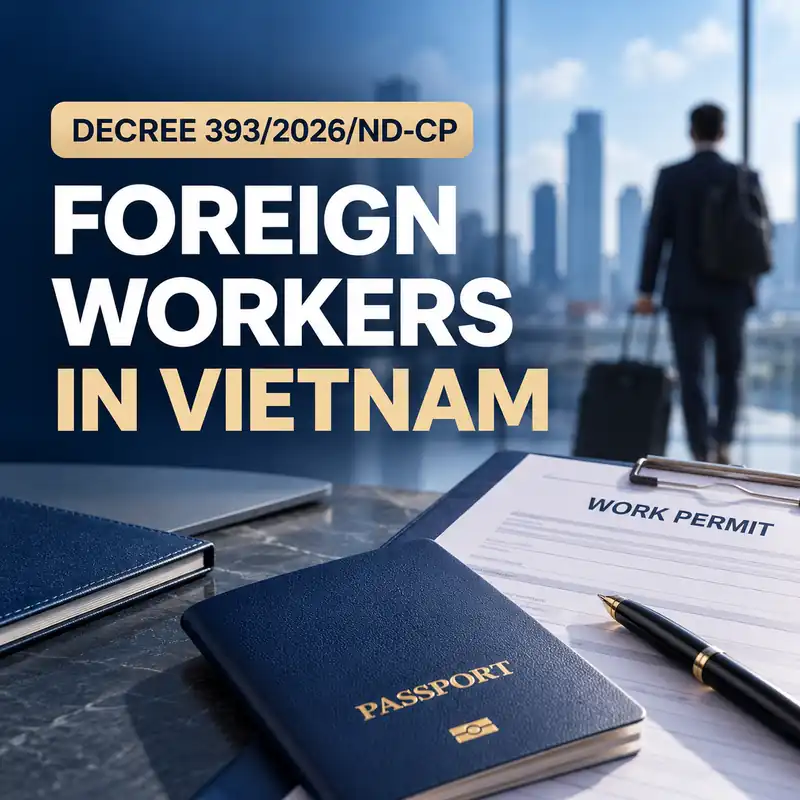
Decree 393/2026/ND-CP: New Regulations on Foreign Workers in Vietnam
Vietnam has introduced a new regulatory framework for foreign nationals working in the country. Decree No. 393/2026/ND-CP, issued on 20 October 2026, governs foreign workers in Vietnam and will take effect on 5 December 2026, replacing Decree No. 219/2025/ND-CP from that date.
The new Decree addresses the conditions and procedures for obtaining, reissuing, extending and revoking work permits, as well as certificates confirming that foreign workers are exempt from work permit requirements. It also specifies categories of foreign workers who are not subject to work permit requirements under applicable provisions of the Labour Code.
For businesses employing foreign nationals, understanding the new rules is important for workforce planning, immigration-related compliance and the preparation of employment documentation.
1. What Is Decree 393/2026/ND-CP?
Decree No. 393/2026/ND-CP is a Government decree regulating foreign workers working in Vietnam. It consists of five chapters and 37 articles covering the relevant administrative procedures and legal requirements.
The Decree regulates, among other matters:
-
The positions in which foreign workers may work in Vietnam.
-
The authority responsible for issuing, reissuing, extending and revoking work permits.
-
The procedures for applying for work permits and certificates confirming work permit exemption.
-
The documents required for relevant applications, including applicable consular legalization and certification requirements.
-
The cases in which work permits or work permit exemption certificates may be revoked.
-
Transitional provisions and implementation responsibilities.
Effective date: 5 December 2026.
Previous regulation: Decree No. 219/2025/ND-CP, which ceases to be effective when Decree No. 393/2026/ND-CP takes effect.
2. Work Permit Procedures for Foreign Workers
Employers should review the new Decree’s procedures before submitting applications involving foreign employees.
The regulatory framework covers the issuance of new work permits, reissuance, extensions and revocation. Each procedure may involve different eligibility conditions and supporting documentation, depending on the employee’s circumstances and the requested administrative action.
Businesses should therefore avoid assuming that the documents and procedures used for one application will automatically be sufficient for another.
Before submitting an application, employers should:
-
Confirm the foreign employee’s intended position and applicable eligibility requirements.
-
Identify the appropriate work permit procedure.
-
Review the required application documents and applicable translation, certification or consular legalization requirements.
-
Check the relevant authority and submission method.
-
Allow sufficient time to complete the procedure before the employee’s intended work commencement or permit expiry date.
The precise requirements should be checked against the applicable provisions of Decree No. 393/2026/ND-CP.
3. Which Authority Handles Work Permit Applications?
Under Decree No. 393/2026/ND-CP, the provincial-level People’s Committee has authority over the issuance, reissuance, extension and revocation of work permits and certificates confirming work permit exemption for foreign workers employed by employers whose relevant offices or business locations are in the locality where the foreign workers are expected to work.
The relevant locations may include an employer’s head office, branch, representative office, business location or the operating office of a foreign contractor.
Employers should assess the relevant location and employment arrangement when determining the appropriate authority for an application.
Where a company operates across multiple provinces, it should pay particular attention to the location associated with the foreign employee’s intended work and the employer’s relevant establishment.
4. Work Permit Exemptions Under Decree 393/2026/ND-CP
Not every foreign national working in Vietnam is necessarily required to obtain a work permit. The applicable exemption depends on the employee’s circumstances and the specific legal provisions governing the case.
Decree No. 393/2026/ND-CP specifies categories of foreign workers who are not subject to work permit requirements under the relevant provisions of the Labour Code.
The categories include certain individuals covered by specific statutory provisions, as well as certain groups identified in the new Decree. These include, subject to the applicable conditions:
-
Individuals holding doctoral degrees who undertake teaching or scientific research at vocational education or higher education institutions.
-
Professors and associate professors engaged in teaching, research or academic exchange at vocational education or higher education institutions.
-
Foreign workers confirmed as eligible by ministries, ministerial-level agencies or provincial-level People’s Committees.
-
Certain individuals eligible for special temporary visa exemptions under the applicable regulations.
-
Certain experts working in strategic technology fields and individuals covered by specific national programmes for attracting artificial intelligence talent.
These categories should not be treated as blanket exemptions. Employers must verify the relevant legal basis and the conditions applicable to each individual.
In addition, exemption from the requirement to obtain a work permit does not necessarily mean that no administrative procedure is required. Depending on the case, a certificate confirming work permit exemption or another applicable procedure may still be necessary.
5. Documents, Translation and Legalization Requirements
Foreign documents submitted in connection with work permit procedures may be subject to translation into Vietnamese, certification and consular legalization requirements, as applicable under Vietnamese law.
Employers should review the document requirements for the particular application rather than relying solely on documents prepared for previous filings.
A practical document review should cover:
-
The validity and consistency of personal and employment-related information.
-
The required form of foreign-issued documents.
-
Vietnamese translations and applicable certification.
-
Consular legalization requirements and any applicable exceptions.
-
The completeness of the application under the relevant provisions of the Decree.
These checks can help reduce avoidable delays caused by incomplete or improperly prepared documents.
6. Online Applications and Criminal Record Information
Decree No. 393/2026/ND-CP also addresses the use of criminal record database information in certain online application procedures.
Where an employer applies online for a work permit or a certificate confirming work permit exemption, the applicant is not required to submit a criminal record certificate in cases where the relevant information can be retrieved from the criminal record database.
The competent authority retrieves the relevant information concerning whether the foreign worker is serving a criminal sentence or has an unexpunged criminal record. In such cases, the processing period is calculated from the time the results of the database retrieval are received.
This provision may reduce the need to submit a separate document in qualifying cases. However, employers should verify whether the database retrieval mechanism applies to their particular application before omitting any document.
7. What Should Employers Do Before 5 December 2026?
With the new Decree scheduled to take effect on 5 December 2026, employers should review their foreign workforce and relevant administrative processes ahead of the implementation date.
Recommended actions include:
1. Review current work permits and exemption documentation.
Check expiry dates, employee details and any upcoming applications for issuance, reissuance or extension.
2. Reassess work permit exemption cases.
Confirm that the legal basis for each exemption remains applicable and identify whether a certificate or another procedure is required.
3. Review application documents.
Check translation, certification, consular legalization and other supporting-document requirements under the new framework.
4. Update internal HR procedures.
Ensure that HR and legal teams understand the new effective date and the procedures relevant to their employees.
5. Check transitional provisions.
For applications, permits or other matters that began under the previous framework, review the transitional provisions in Decree No. 393/2026/ND-CP rather than assuming that all existing cases will be treated identically.
8. Frequently Asked Questions
When does Decree 393/2026/ND-CP take effect?
The Decree takes effect on 5 December 2026.
Does Decree 393/2026/ND-CP replace Decree 219/2025/ND-CP?
Yes. Decree No. 219/2025/ND-CP ceases to be effective when Decree No. 393/2026/ND-CP takes effect.
Does every foreign worker in Vietnam need a work permit?
No. Certain foreign workers may fall within statutory exemptions. Eligibility must be assessed under the applicable provisions and the individual’s specific circumstances.
Can employers apply for work permits online without submitting a criminal record certificate?
In qualifying online applications, a separate criminal record certificate is not required where the relevant information can be retrieved from the criminal record database, subject to the conditions specified in the Decree.
What should employers do before the new rules take effect?
Employers should review existing permits, exemption cases, upcoming applications, supporting documents and internal compliance procedures. They should also assess the transitional provisions for matters already in progress.
Disclaimer: This article provides general information on Vietnamese law and is not legal advice. The application of specific requirements depends on the relevant legal provisions and the facts of each case. Businesses should consult the official legal text and obtain professional advice where necessary.
The practical measures discussed in this article are general compliance considerations and should not be interpreted as a statement that every measure constitutes a specific statutory obligation for every importer. Businesses should review the full legal text, relevant product lists, applicable international commitments, and any sector-specific rules before making import or sourcing decisions.
For advice tailored to your specific circumstances, please contact LTS LAW FIRM for further consultation and legal assistance.
LTS LAW FIRM
Floor 6, 520 Cach Mang Thang Tam
Nhieu Loc Ward, Ho Chi Minh City, Vietnam
Tel: (+84) 965 000 524
Email: contact@lts.com.vn
Working hours: Monday – Friday, 8 AM – 6 PM VNT