Tiếng Việt
 日本語
 中文 (中国)
 ไทย
 हिन्दी
 한국어
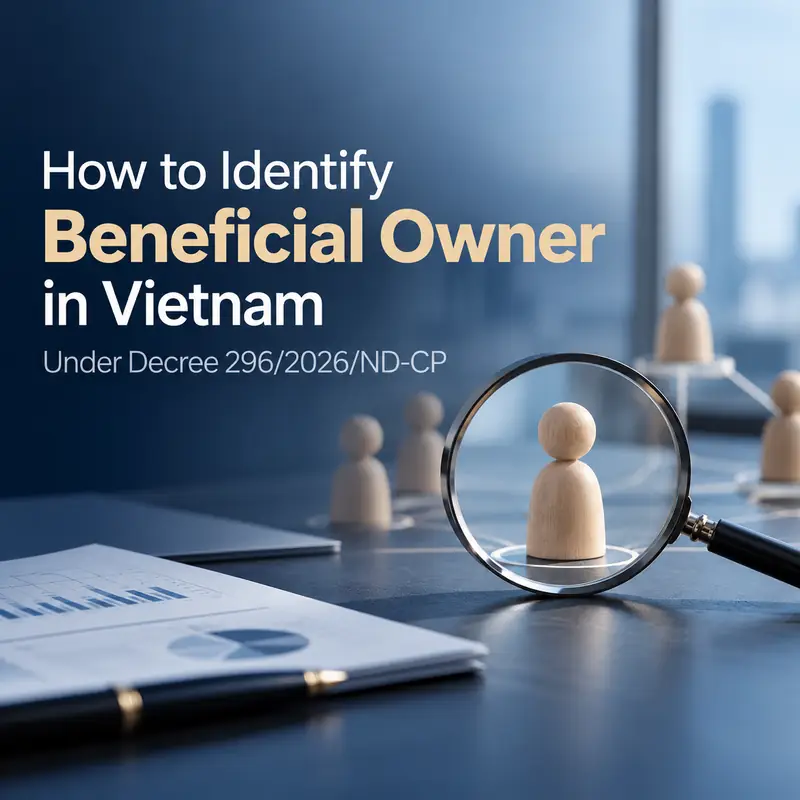
How to Identify Beneficial Owners in Vietnam Under Decree 296/2026/ND-CP
Identifying beneficial owners is an important part of corporate transparency and enterprise registration compliance in Vietnam. Businesses must look beyond their registered shareholders and consider who ultimately owns or exercises actual control over the enterprise.
On 23 July 2026, the Vietnamese Government issued Decree No. 296/2026/ND-CP, amending Decree No. 168/2025/ND-CP on enterprise registration. The amendments clarify the criteria for identifying beneficial owners and establish a priority order for declaring their information to the business registration authority. Decree No. 296/2026/ND-CP took effect on the date of issuance.
This article explains how businesses can identify beneficial owners under the updated regulations, assess direct and indirect ownership, determine actual controlling interests, and understand the associated declaration obligations.
1. What Is a Beneficial Owner in Vietnam?
Under Clause 35, Article 4 of the Law on Enterprises 2020, as amended and supplemented by Law No. 76/2025/QH15, a beneficial owner of an enterprise with legal personality is an individual who has actual ownership of the enterprise’s charter capital or the right to control the enterprise, subject to the statutory exclusions applicable to representatives of state capital.
Article 17 of Decree No. 168/2025/ND-CP, as amended by Decree No. 296/2026/ND-CP, further clarifies that a beneficial owner is one or more individuals who directly or indirectly own, or ultimately exercise actual control over, the enterprise.
Accordingly, beneficial ownership is not limited to the individuals whose names appear in the enterprise’s shareholder or member registers. A business may need to examine its ownership chain and governance arrangements to identify the individuals who ultimately own or control it.
For enterprises with foreign shareholders, parent companies or multiple layers of corporate ownership, this assessment may require reviewing the entire ownership structure rather than relying solely on the immediate shareholders of the Vietnamese entity.
2. What Are the Criteria for Identifying Beneficial Owners in Vietnam?
Under Article 17 of Decree No. 168/2025/ND-CP, as amended by Article 3 of Decree No. 296/2026/ND-CP, beneficial owners are identified through an ordered assessment of ownership, actual control and, where neither criterion identifies a beneficial owner, the enterprise manager with the highest authority.
2.1. Direct or indirect ownership of at least 25%
An individual qualifies under the ownership criterion if they directly or indirectly, or through a combination of direct and indirect ownership, own at least 25% of:
-
The enterprise’s charter capital; or
-
The total number of voting shares of the enterprise.
The threshold is 25% or more, not more than 25%. Therefore, an individual holding exactly 25% may qualify.
Direct ownership
Direct ownership occurs when an individual holds the relevant capital contribution or voting shares directly in the Vietnamese enterprise.
Example:
Company A has the following individual shareholders:
| Shareholder | Ownership |
|---|---|
| Individual X | 40% |
| Individual Y | 35% |
| Individual Z | 25% |
All three individuals meet the 25% ownership threshold and should be assessed as beneficial owners under the ownership criterion.
The company should not identify only the majority shareholder while overlooking other individuals who independently meet the threshold.
Indirect ownership
Indirect ownership arises when an individual owns the Vietnamese enterprise through one or more intermediary organizations or other legal arrangements.
Example:
Individual X owns 60% of Holding Company B. Holding Company B owns 50% of the charter capital of Vietnamese Company A.
For illustrative purposes, the indirect economic ownership can be calculated as follows:
60% × 50% = 30%.
Individual X therefore has an indirect ownership interest equivalent to 30% through this ownership chain, exceeding the 25% threshold.
In practice, businesses should map each ownership layer, review the relevant corporate and legal arrangements, and assess the applicable ownership interests before determining which individuals must be declared.
2.2. Individuals in certain family-related or contractual ownership groups
The amended regulations also address groups of individuals who have family relationships as specified in Clause 22, Article 4 of the Law on Enterprises, or who have entered into a contract under which they jointly own, directly or indirectly, at least 25% of the enterprise’s charter capital or voting shares.
In these circumstances, the enterprise must identify the individuals in the qualifying group as beneficial owners.
Example:
Two individuals have a qualifying family relationship under the Law on Enterprises and hold 15% and 10%, respectively, of a company’s charter capital.
Although neither individual independently reaches 25%, the enterprise must assess the statutory family-group rule. If the relationship and combined ownership satisfy the applicable conditions, both individuals must be identified as beneficial owners under that rule.
Businesses should not automatically aggregate the holdings of every relative. The relationship must fall within the statutory definition, and the applicable ownership conditions must be satisfied.
2.3. General partners of a partnership
For a partnership, all general partners are considered beneficial owners regardless of their respective capital contribution ratios or voting rights.
This is a specific statutory rule. Consequently, an enterprise should not apply the 25% threshold as the sole test for determining beneficial owners of a partnership.
2.4. Actual control over the enterprise
An individual may qualify as a beneficial owner even if they do not meet the ownership threshold.
Under Clause 2, Article 17 of Decree No. 168/2025/ND-CP, as amended by Decree No. 296/2026/ND-CP, where no individual satisfies the ownership criterion, or there are grounds to establish that an individual identified under that criterion is not the beneficial owner, the enterprise must identify its beneficial owner through other methods under the law or in practice.
Actual control may be exercised through one or more of the following rights:
-
Appointing, dismissing or removing a majority or all members, or the chairperson, of the Board of Directors or Members’ Council, or the Director or General Director.
-
Amending or supplementing the enterprise’s charter.
-
Changing the enterprise’s organizational structure.
-
Deciding the enterprise’s financial, investment and operational policies.
-
Reorganizing or dissolving the enterprise.
Example:
Individual X holds only 10% of a company’s charter capital but has contractual rights that enable X to determine the company’s investment policies and exercise qualifying control over key corporate decisions.
If the rights and actual circumstances satisfy the statutory control criterion, X may qualify as a beneficial owner despite holding less than 25% of the capital.
The enterprise should therefore examine not only its shareholder register but also its charter, shareholders’ agreements, voting arrangements, appointment rights and other relevant governance documents.
2.5. The enterprise manager with the highest authority
If no individual satisfies either the ownership or actual-control criteria, the enterprise must identify one individual who is the enterprise manager with the greatest authority to act on behalf of the enterprise.
This is a fallback criterion rather than the default approach.
Businesses should first assess ownership and actual control. They should not automatically declare the legal representative, Director or General Director without considering whether an individual satisfies the preceding criteria and which manager has the greatest authority in the relevant circumstances.
An individual representing state capital in the enterprise is excluded from this fallback criterion.
3. What Is the Required Order for Identifying Beneficial Owners?
Under Clause 2, Article 18 of Decree No. 168/2025/ND-CP, as amended by Decree No. 296/2026/ND-CP, beneficial ownership information must be declared according to the prescribed order.
| Step | Assessment | Action |
|---|---|---|
| 1 | Ownership criterion | Identify individuals who meet the ownership threshold or another applicable ownership rule under Article 17. |
| 2 | Actual-control criterion | If the ownership criterion does not identify the beneficial owner, or there are grounds to question the result, identify individuals who exercise qualifying actual control. |
| 3 | Highest-authority manager | If no individual satisfies either preceding criterion, identify the enterprise manager with the greatest authority to act on behalf of the enterprise, subject to the statutory exclusion. |
The priority order matters. Businesses should document the assessment at each stage rather than selecting a manager simply because no shareholder appears to hold a majority interest.
The declaration process should also reflect the actual ownership and control structure, including relevant indirect holdings and contractual arrangements.
4. How Can Businesses Identify Beneficial Owners in Practice?
A structured review can help businesses determine which individuals meet the statutory criteria and prepare accurate declaration information.
Step 1: Review the enterprise’s ownership structure
Collect the current charter, shareholder or member registers, capital contribution records and other relevant corporate documents.
Identify each direct shareholder or capital contributor and record their ownership percentage and voting rights.
Step 2: Trace indirect ownership
Where a shareholder is an organization, review its ownership structure and trace the chain through intermediary entities until the relevant individuals can be identified.
For a multi-layered structure, document each ownership link and assess the individual’s indirect ownership interest. Review other legal arrangements where relevant.
Step 3: Assess family-related and contractual ownership groups
Determine whether any individuals fall within the family relationships specified by the Law on Enterprises or are parties to a qualifying contract for joint ownership.
Assess whether the statutory conditions are satisfied before identifying the relevant individuals as beneficial owners.
Step 4: Examine actual controlling rights
Review the enterprise’s charter, shareholders’ agreements, voting arrangements, appointment and removal rights, and other relevant governance documents.
Determine whether any individual exercises one or more of the controlling rights specified in Article 17.
Step 5: Apply the fallback criterion if necessary
If no individual meets the ownership or actual-control criteria, determine which enterprise manager has the greatest authority to act on behalf of the enterprise.
Apply the statutory exclusion for individuals representing state capital.
Step 6: Prepare and declare the required information
The enterprise founder or enterprise must identify its beneficial owners and declare the relevant information to the business registration authority in accordance with Article 18 of Decree No. 168/2025/ND-CP, as amended by Decree No. 296/2026/ND-CP.
The information declared should be consistent with the enterprise’s actual ownership and control structure and the applicable registration requirements.
Step 7: Retain supporting records and review relevant changes
Maintain the documents used to determine beneficial ownership, including ownership records, organizational charts, relevant agreements and the rationale for identifying each individual.
When ownership, voting rights, contractual arrangements or control rights change, assess whether the enterprise must update its beneficial ownership information or complete relevant enterprise registration procedures.
5. What Information and Documents Should Businesses Review?
The precise information and filing requirements should be checked against the applicable registration forms and legal provisions. As a practical matter, the following records can help establish beneficial ownership.
| Document or record | Purpose |
|---|---|
| Enterprise charter | Review ownership, governance and decision-making arrangements. |
| Shareholder or member register | Identify direct owners and their holdings. |
| Capital contribution records | Verify charter capital contributions and ownership percentages. |
| Corporate ownership chart | Trace indirect ownership through intermediary entities. |
| Shareholders’ agreements and other relevant contracts | Assess joint ownership, voting arrangements and actual controlling rights. |
| Board and Members’ Council records | Review appointment rights, governance decisions and the exercise of control. |
| Relevant registration and declaration records | Check consistency between previously declared information and the current structure. |
This list is a practical review checklist, not an exhaustive statutory list of documents that must accompany every declaration.
6. What Are the Declaration Obligations for Existing Enterprises?
Enterprises should distinguish between the obligation to identify and declare beneficial owners when carrying out applicable registration procedures and the question of whether an existing enterprise must immediately refile information solely because the legal criteria have changed.
Decree No. 296/2026/ND-CP amended the criteria for identifying beneficial owners and the order for declaring their information. However, the Ministry of Finance clarified that the Decree does not require every existing enterprise to review and update beneficial ownership information within 10 days solely because the Decree took effect.
The Government’s published explanation also notes that the Decree did not amend the general 10-day notification provision in Clause 1, Article 52 of Decree No. 168/2025/ND-CP or introduce a separate transitional deadline requiring all existing enterprises to refile immediately.
Accordingly, businesses should assess their specific circumstances and applicable registration obligations rather than assuming that the new criteria automatically trigger an immediate filing deadline for every enterprise.
Enterprises established before 1 July 2025 should pay particular attention to the rules governing the supplementation of beneficial ownership information when they next register or notify changes to enterprise registration information.
7. What Are the Penalties for Non-Compliance?
Decree No. 288/2026/ND-CP amended the administrative penalty framework under Decree No. 122/2021/ND-CP, including provisions relating to beneficial ownership information.
The applicable consequences depend on the specific violation and the circumstances in which it occurs.
For example, under Clause 6, Article 44 of Decree No. 122/2021/ND-CP, as amended by Decree No. 288/2026/ND-CP, an enterprise established before 1 July 2025 may face a fine of VND 70 million to VND 100 million if it fails to supplement beneficial ownership information, where applicable, or information used to identify beneficial owners when carrying out its most recent procedure for registering or notifying changes to enterprise registration information.
The provision also requires remedial action to supplement the relevant information.
Other violations, including inaccurate or untruthful declarations and failures to provide information when requested by competent authorities, are governed by separate provisions and may carry different penalties.
The VND 70–100 million range should therefore not be interpreted as an automatic penalty for every beneficial ownership declaration issue. Businesses should assess the exact conduct, applicable provision and relevant facts before determining potential liability.
8. Common Mistakes When Identifying Beneficial Owners
Businesses should avoid the following mistakes when reviewing their beneficial ownership information:
Identifying only the majority shareholder. More than one individual may meet the 25% ownership threshold.
Ignoring indirect ownership. A corporate shareholder may sit between an individual and the Vietnamese enterprise.
Applying the 25% threshold in isolation. Certain family-related groups, qualifying contractual arrangements and general partners are subject to specific rules.
Assuming that a person with less than 25% cannot be a beneficial owner. An individual may qualify through actual control.
Automatically declaring the legal representative. The manager-with-the-greatest-authority criterion applies only where the preceding ownership and control criteria do not identify a beneficial owner.
Failing to review governance documents. Shareholders’ agreements, appointment rights and decision-making arrangements may reveal control that is not apparent from the ownership percentages alone.
Treating the change in legal criteria as an automatic filing deadline. Existing enterprises should review the applicable transitional position and registration obligations before deciding when an update is required.
9. Frequently Asked Questions
9.1. Who qualifies as a beneficial owner in Vietnam?
A beneficial owner is an individual who meets the applicable ownership or actual-control criteria under the Law on Enterprises and Decree No. 168/2025/ND-CP, as amended by Decree No. 296/2026/ND-CP. If no individual meets either criterion, the enterprise must apply the prescribed fallback criterion.
9.2. Is exactly 25% ownership sufficient?
Yes. The threshold is at least 25% of the charter capital or total voting shares. An individual holding exactly 25% meets the numerical threshold, subject to the applicable rules.
9.3. Can an individual with less than 25% ownership be a beneficial owner?
Yes. An individual may qualify if they exercise actual control through one or more of the rights specified in Article 17, even if their ownership interest is below 25%.
9.4. Must a company declare every individual shareholder?
Not necessarily. The declaration must follow the applicable statutory criteria and order. Individuals who meet the beneficial ownership criteria must be identified; the fact that someone is a shareholder does not, by itself, mean that the person qualifies under the 25% ownership threshold.
9.5. How should indirect ownership be assessed?
Businesses should trace the ownership chain through intermediary organizations or other legal arrangements to identify the individuals who ultimately own the enterprise. Each ownership layer and the applicable legal arrangements should be reviewed.
9.6. Does every existing enterprise need to refile its beneficial ownership information immediately?
No automatic 10-day refiling requirement arises solely from the entry into force of Decree No. 296/2026/ND-CP. The Ministry of Finance has clarified that the Decree did not introduce such a general requirement for all existing enterprises. The enterprise’s particular circumstances and applicable registration obligations must still be assessed.
9.7. What happens if an enterprise fails to supplement beneficial ownership information?
The consequences depend on the specific violation. Certain enterprises established before 1 July 2025 may face fines of VND 70 million to VND 100 million for failing to supplement the relevant information when carrying out the specified registration or notification procedures. Other violations are governed by separate provisions.
9.8. What should a foreign-invested enterprise do first?
A foreign-invested enterprise should begin by mapping its direct and indirect ownership structure, identifying the relevant individual owners, reviewing contractual and governance rights, and applying the statutory priority order before preparing its declaration.
Disclaimer
This article provides general information on identifying beneficial owners of enterprises in Vietnam under Decree No. 296/2026/ND-CP and relevant provisions of Vietnamese enterprise law. It is for informational purposes only and does not constitute legal advice. Businesses should consult the official legal texts and seek professional legal advice to assess their specific ownership structures, declaration obligations and compliance requirements.
The practical measures discussed in this article are general compliance considerations and should not be interpreted as a statement that every measure constitutes a specific statutory obligation for every importer. Businesses should review the full legal text, relevant product lists, applicable international commitments, and any sector-specific rules before making import or sourcing decisions.
For advice tailored to your specific circumstances, please contact LTS LAW FIRM for further consultation and legal assistance.
LTS LAW FIRM
Floor 6, 520 Cach Mang Thang Tam
Nhieu Loc Ward, Ho Chi Minh City, Vietnam
Tel: (+84) 965 000 524
Email: contact@lts.com.vn
Working hours: Monday – Friday, 8 AM – 6 PM VNT