Tiếng Việt
In an ongoing endeavor to enhance the investment and business environment, Vietnam’s National Assembly has implemented groundbreaking adjustments to the legal framework governing conditional business lines. This movement is designed not only to simplify administrative procedures but also demonstrates the Government’s strong commitment to creating maximum favorable conditions for the business community, particularly Foreign Direct Investors (FDI).
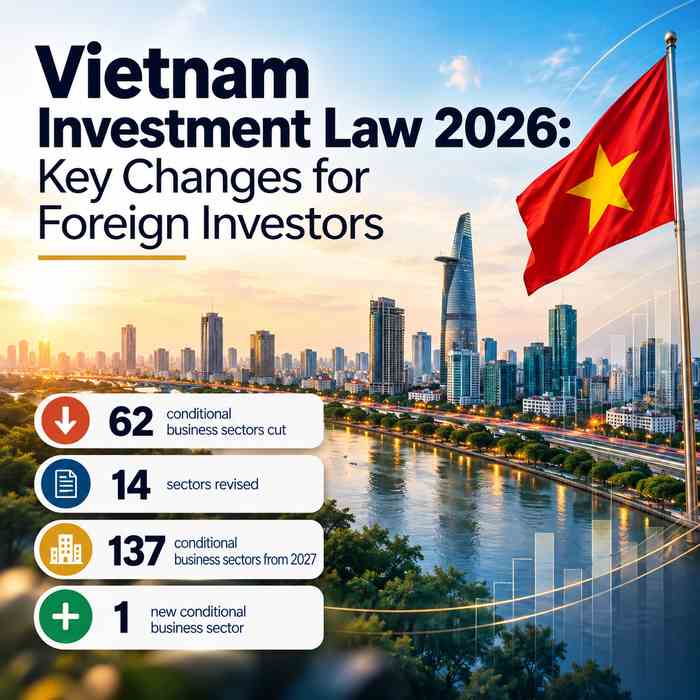
According to the latest draft amendments, a significant number of 38 conditional business lines have been cut, and 20 other business lines have been revised towards liberalization or altered forms of management. In total, 58 business lines are impacted by this reform wave, creating substantial liberalization. For foreign investors, this is a golden opportunity to accelerate market entry, reduce compliance costs, and focus resources on core business development. LTS LAW FIRM provides an in-depth analysis of the implications of these changes, helping you optimize your investment strategy in Vietnam.
I. COMPREHENSIVE IMPACT OF THE REDUCTION AND AMENDMENT
This legal reform directly impacts two key aspects of conditional business regulations, bringing clear benefits to investors.
1. Eliminating 38 Industries and Occupations: Removing Barriers to Market Entry
The complete removal of 38 industries and occupations from the list of conditional business activities means that businesses operating in these fields will no longer have to meet complex requirements regarding licensing conditions, registered capital, professional certificates, or professional inspection requirements before operating.
Accordingly, the following is a list of 38 conditional business sectors that have been reduced:
|
No. |
Business Line |
Sector |
|
1 |
Services for tax procedures |
Finance, Accounting, Trade |
|
2 |
Services for customs procedures |
Finance, Accounting, Trade |
|
3 |
Insurance auxiliary services |
Finance, Accounting, Trade |
|
4 |
Commercial assessment services |
Finance, Accounting, Trade |
|
5 |
Temporary import, re-export of goods subject to special consumption tax |
Finance, Accounting, Trade |
|
6 |
Temporary import, re-export of frozen food |
Finance, Accounting, Trade |
|
7 |
Temporary import, re-export of used goods on the restricted list |
Finance, Accounting, Trade |
|
8 |
Energy audit |
Finance, Accounting, Trade |
|
9 |
Employment service business |
Culture, Society, and Health |
|
10 |
Labor subleasing services |
Construction, Transport |
|
11 |
Car maintenance and warranty services |
Construction, Transport |
|
12 |
Services for building, modifying, repairing, restoring inland waterway vehicles |
Construction, Transport |
|
13 |
Maritime safety assurance services |
Construction, Transport |
|
14 |
Seagoing vessel towing services |
Construction, Transport |
|
15 |
Services for building, modifying, repairing seagoing vessels |
Construction, Transport |
|
16 |
Flight operation assurance services |
Construction, Transport |
|
17 |
Multimodal transport services |
Construction, Transport |
|
18 |
Architectural services |
Construction, Transport |
|
19 |
Construction activities of foreign contractors |
Construction, Transport |
|
20 |
Practice of construction investment cost management services |
Construction, Transport |
|
21 |
Services for managing and operating apartment buildings |
Construction, Transport |
|
22 |
Services for managing and operating crematories |
Culture, Society, and Health |
|
23 |
Data center services |
Technology, Land |
|
24 |
Overseas study consulting services |
Culture, Society, and Health |
|
25 |
Rearing and cultivation of wild flora and fauna specified in CITES Appendices and the List of endangered, precious, and rare forest flora, fauna, and aquatic resources |
Agriculture, Forestry, Fishery |
|
26 |
Rearing ordinary forest animals |
Agriculture, Forestry, Fishery |
|
27 |
Export, import, re-export, transit, and introduction from the sea of natural specimens of species specified in CITES Appendices and the List of endangered, precious, and rare forest flora, fauna, and aquatic resources |
Agriculture, Forestry, Fishery |
|
28 |
Export, import, re-export of breeding, growing, artificially propagated specimens of species specified in CITES Appendices and the List of endangered, precious, and rare forest flora, fauna, and aquatic resources |
Agriculture, Forestry, Fishery |
|
29 |
Processing, trading, transporting, advertising, displaying, and storing specimens of flora and fauna species specified in CITES Appendices and the List of endangered, precious, and rare forest flora, fauna, and aquatic resources |
Agriculture, Forestry, Fishery |
|
30 |
Trading food under the specialized management of the Ministry of Agriculture and Rural Development |
Agriculture, Forestry, Fishery |
|
31 |
Services for animal quarantine and animal product quarantine isolation |
Agriculture, Forestry, Fishery |
|
32 |
Cosmetic surgery services |
Culture, Society, and Health |
|
33 |
Services for inspection, calibration, and testing of measuring instruments and standards |
Technology, Land |
|
34 |
Services for artistic performance, fashion shows, beauty contests, and model competitions |
Culture, Society, and Health |
|
35 |
Services for building information technology infrastructure, developing software for the land information system |
Technology, Land |
|
36 |
Services for building land databases |
Technology, Land |
|
37 |
Printing and minting currency |
Finance, Accounting, Trade |
|
38 |
Archiving services |
Finance, Accounting, Trade |
2. Revising 20 Industries and Occupations: Shifting Management Methods
For the 20 industries and occupations being revised, the focus is on shifting management methods from pre-operation inspection to post-operation inspection or management using specialized technical standards and regulations.
- Optimizing Resources: The new conditions will be designed more rationally, focusing on output results (quality, safety) rather than input processes (requirements for personnel, capital).
- Flexible Operations: Businesses can be more proactive in applying new technologies and processes, as long as they meet the prescribed technical standards.
II. CHALLENGES AND OPPORTUNITIES
While the cuts represent positive news, foreign investors must clearly understand which hurdles have been removed and which remain.
Opportunities for Accelerated Investment
The reduction of sub-licenses allows FDI projects to move from concept to implementation faster than ever. Service, trade, and certain small-to-medium-sized manufacturing sectors will see the biggest impact. Investors can utilize the first-mover advantage in these newly liberalized fields.
- Simplified Documentation: Significantly reduces the necessary documents when applying for the ERC and Investment Registration Certificate (IRC), helping reduce administrative burdens and speeding up the time to operation.
- Increased Predictability and Transparency: Helps investors easily assess legal risks and project implementation timelines, eliminating ambiguity and arbitrary discretion in the licensing process.
Unchanged Challenges: What Remains Constant?
It is crucial to note that “cutting conditional business lines” does not mean “no regulation.” Investors must still adhere strictly to mandatory procedures.
- Market Access Restrictions Remain: Certain key sectors (e.g., finance, telecom, media) still maintain Foreign Ownership Limits (FOLs) or specific investment forms stipulated by Vietnam’s commitments under the WTO and FTAs. These restrictions are separate from the conditional business line structure and must be strictly complied with.
- Post-Licensing Compliance: General operational requirements, such as tax reporting, labor safety, environmental protection approvals, and quality control standards, remain fully in effect.
- Land and Construction: Procedures related to land use rights and construction permits, which are often major time sinks for FDI, are governed by separate laws (Land Law, Construction Law) and are not directly simplified by this reform.
III. LEGAL REQUIREMENTS IN VIETNAM POST-REFORM
While the licensing burden is reduced, the obligation to comply with all other applicable laws remains absolute. Foreign investors must shift their focus.
1. Strict Compliance with Non-License Regulations
For the 38 liberalized business lines, enterprises must prioritize internal compliance management across:
- Technical Standards: Ensuring products/services meet required national technical regulations and standards.
- Safety and Health: Full compliance with labor, fire safety, and public health regulations.
- Environmental Protection: Collecting all necessary environmental permits and adhering to environmental laws (these regulations are separate from general business licenses).
2. Foreign Ownership Limits (FOLs) Remain Unchanged
The abolition of these 38 business licenses does not impact existing limitations on foreign ownership (FOLs) or other market access restrictions determined by Vietnam’s commitments under the WTO, CPTPP, or other FTAs. These restrictions remain in full effect and require careful legal structuring.
IV. How LTS LAW Supports This Reform Transition Phase
LTS LAW FIRM specializes in guiding foreign investors through critical legislative shifts, ensuring both optimal strategy and strict compliance. The period leading up to 2026 is a crucial time for planning.
Our specialized services include:
- Impact Analysis: Reviewing your planned investment against the official list of 38 abolished lines to determine the exact market entry timeline and remaining compliance requirements.
- Integrated Licensing Pathway: Managing the synchronized application for your IRC and ERC
- Post-Check Compliance Consulting: Establishing robust internal compliance processes to ensure your business meets all technical standards and non-licensing regulations from day one of operation.
- Structuring for Incentives: Assisting with project structuring to secure available Investment Incentives
Leverage this legislative change to gain a competitive advantage. Our expertise ensures your clients’ investment is deployed effectively and fully compliant.
The official abolition of 38 business licenses is clear evidence of Vietnam’s determination to build a modern, transparent, and dynamic investment environment. This simplification offers an unprecedented opportunity to maximize investment efficiency.
To fully capitalize on this opportunity and effectively navigate the remaining legal requirements, the presence of specialized legal counsel is indispensable.
LTS LAW – Dedicated Legal Support in Ho Chi Minh City
LTS LAW specializes in legal consulting and handling matters for individuals and businesses, including company formation, licensing, foreign investment advisory, contract drafting, and dispute resolution.
📌 Office Address: 520 Cach Mang Thang Tam Street, Nhieu Loc Ward, Ho Chi Minh City
📞 Hotline/Zalo: +84 902 798 066 / +84 965 000 524
🌐 Website: https://lts.com.vn
Contact LTS LAW for tailored, accurate, and case-specific legal advice for your business.