Tiếng Việt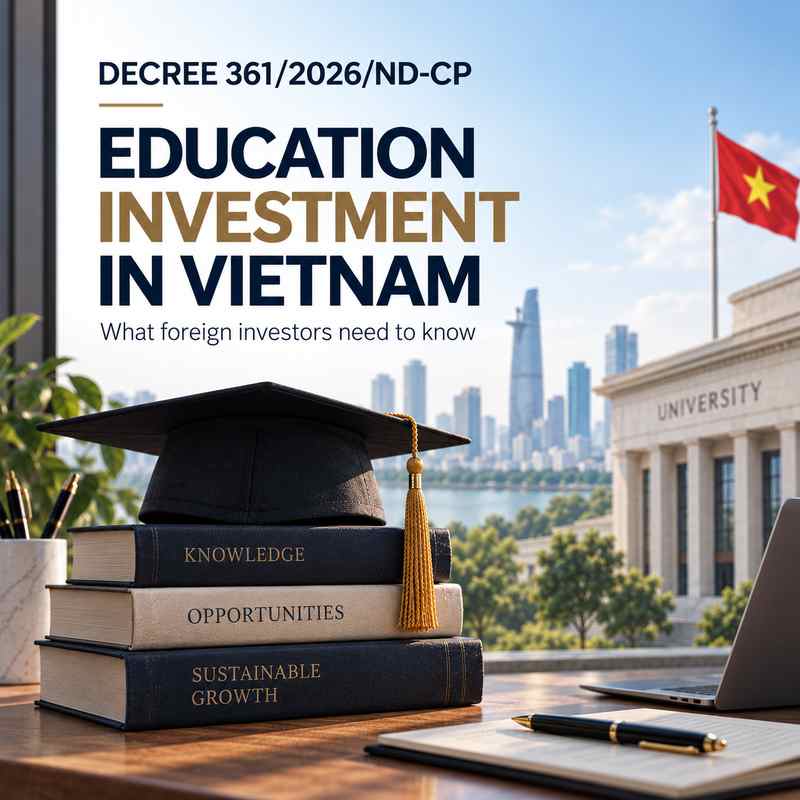
Decree 361/2026/ND-CP: New Investment Conditions for Education in Vietnam
Vietnam has introduced a new regulatory framework governing investment and operations in vocational education, higher education, and educational quality accreditation.
On 17 September 2026, the Government issued Decree No. 361/2026/ND-CP, which sets out conditions for the establishment and operation of educational institutions, including private higher education institutions with foreign investors and branches of foreign higher education institutions in Vietnam.
For investors considering education investment in Vietnam, the new requirements are particularly relevant to investment capital, facilities, leasing arrangements, capital transfer obligations, and licensing conditions.
1. What Does Decree 361/2026/ND-CP Regulate?
Decree 361/2026/ND-CP provides conditions and procedures relating to the establishment and operation of:
-
Vocational education institutions;
-
Higher education institutions;
-
Private higher education institutions established by domestic or foreign investors;
-
Branches of foreign higher education institutions in Vietnam; and
-
Educational quality accreditation organizations.
The Decree also addresses matters such as licensing, changes to training locations, mergers, divisions, separations, suspension of enrollment, suspension of operations, and dissolution.
For foreign investors, the provisions concerning higher education institutions and foreign university branches are particularly relevant.
2. Capital and Facility Requirements for Private Higher Education Institutions
One of the key considerations under Decree 361/2026/ND-CP is the investment value required for a private higher education institution.
For a private higher education institution, the investment capital does not include the value of land use rights.
At the time of appraisal, the actual investment value of completed facilities, technical infrastructure, equipment and other tangible assets at the main campus must reach at least VND 300 billion.
The relevant assets must be completed and accepted and may be subject to audit or valuation requirements under the applicable regulations.
This means that investors should not assess the capital requirement solely based on the amount stated in an investment proposal. The structure and actual deployment of assets may also affect whether the project satisfies the conditions for establishment.
3. Specific Rules for Foreign Investors Using Leased Facilities
Decree 361/2026/ND-CP provides a specific mechanism for private higher education institutions established by foreign investors where the project uses leased facilities or facilities contributed by a Vietnamese party.
In this case, the actual investment value of facilities, technical infrastructure and equipment at the main campus must reach at least VND 200 billion at the time of appraisal.
The facilities must also satisfy the applicable requirements concerning stability and duration of use.
For leased facilities, the lease arrangement should therefore be reviewed carefully before the investment structure is finalized.
Why Does This Matter to Foreign Investors?
The possibility of using leased facilities may provide greater flexibility when structuring an education investment project in Vietnam. However, the investor should consider the lease arrangement together with:
-
The value of qualifying assets;
-
The duration and stability of the lease;
-
The timing of capital contribution;
-
Employee and operating costs;
-
The transfer of assets and funds to the educational institution; and
-
Long-term financial commitments.
In practice, investment structuring and licensing compliance should be considered together, rather than treated as separate stages.
4. Additional Capital and Staffing Commitments
Foreign investors using the above mechanism are subject to additional commitments concerning the financial resources required for the operation of the educational institution.
Within the prescribed period after being permitted to establish the institution, the investor must transfer sufficient funds to cover salaries and related costs for lecturers and supporting educational personnel corresponding to the expected training scale and development plan for the required period.
The investor must also commit to transferring the remaining investment capital necessary to maintain and operate the educational institution.
Failure to comply with investment commitments may result in measures including the suspension of new enrollment until the relevant investment obligations are fulfilled.
This makes post-establishment compliance an important consideration when planning the project’s financing structure.
5. Requirements for Branches of Foreign Higher Education Institutions
Another significant area under Decree 361/2026/ND-CP concerns the establishment of a branch of a foreign higher education institution in Vietnam.
A foreign higher education institution seeking to establish a branch in Vietnam must be lawfully established and operating in its home country and satisfy specific requirements concerning its international standing and quality assurance.
In particular, the foreign higher education institution must be among the top 500 higher education institutions in recognized international rankings in one of the three years immediately preceding the application for establishment.
The foreign institution must also maintain an internal quality assurance system and satisfy applicable accreditation or quality assurance requirements.
Therefore, the eligibility of the foreign parent institution itself becomes an important part of the Vietnamese licensing assessment.
6. Requirements for Facilities and Investment Capital of Foreign University Branches
The establishment of a foreign university branch also involves requirements concerning land, facilities, infrastructure and investment capital.
For a newly established branch, the relevant site must satisfy requirements corresponding to the expected training scale.
For a private higher education institution, investment capital must be lawful and does not include the value of land use rights.
At the appraisal stage, the actual investment value of facilities, technical infrastructure, equipment and other tangible assets at the branch location must reach at least VND 100 billion, subject to the applicable audit or valuation requirements.
Foreign investors should therefore assess the proposed location and facility arrangement before finalizing the investment and licensing structure.
7. Key Compliance Issues for Education Investors in Vietnam
For investors preparing an education project in Vietnam, Decree 361/2026/ND-CP highlights several areas requiring early legal review.
7.1. Investment Structure
Investors should determine:
-
The appropriate investment vehicle;
-
The identity and role of each investor;
-
The proposed capital contribution structure;
-
The source and deployment of investment capital; and
-
The ownership or use structure for project assets.
7.2. Facilities and Asset Valuation
The project should identify which assets can be included in the relevant investment value and whether audit or valuation documentation will be required.
This is particularly important where the project relies on existing facilities or assets contributed by another party.
7.3. Lease Arrangements
Where leased facilities are used, investors should review:
-
Lease term;
-
Renewal arrangements;
-
Stability of the right to use the premises;
-
Permitted use of the facilities; and
-
Consistency between the lease arrangement and the project’s licensing requirements.
7.4. Capital Transfer and Implementation Timeline
Investors should also prepare a clear timeline for capital contribution and transfer of assets and funds following the establishment approval.
Meeting the conditions at the appraisal stage does not necessarily eliminate subsequent investment obligations.
7.5. Long-Term Compliance
The project should be assessed not only for its ability to obtain an establishment or investment approval but also for its ability to maintain compliance throughout its operation.
This includes financial commitments, staffing, facilities, training scale and other operational requirements.
8. What Should Foreign Investors Do Before Investing in Vietnam’s Education Sector?
For foreign investors considering establishing a school, university, training institution or foreign university branch in Vietnam, a legal review should ideally take place before the investment structure is finalized.
The review should cover:
-
Eligibility of the investor and proposed investment structure;
-
Applicable capital requirements;
-
Ownership or lease structure for facilities;
-
Asset valuation and supporting documentation;
-
Capital contribution and transfer timeline;
-
Licensing and establishment procedures;
-
Staffing and operational requirements; and
-
Ongoing compliance obligations after licensing.
This approach can help investors identify potential licensing issues before significant capital is committed to the project.
9. How LTS Law Can Support Education Investment in Vietnam
Education investment involves multiple legal considerations, from market entry and investment structuring to licensing and ongoing regulatory compliance.
LTS Law can support investors and businesses in assessing the legal framework applicable to education projects in Vietnam, including:
-
Foreign investment advisory;
-
Investment structuring;
-
Corporate and licensing advisory;
-
Legal due diligence;
-
Regulatory compliance; and
-
Legal support during the implementation of investment projects in Vietnam.
For investors planning to establish or expand an education business in Vietnam, early legal assessment can help align the investment structure, capital plan, facilities and licensing strategy with the applicable regulatory requirements.
Conclusion
Decree 361/2026/ND-CP, effective from 17 September 2026, introduces important requirements for investment and operations in vocational and higher education in Vietnam.
For foreign investors, key considerations include investment capital, facilities, lease arrangements, capital transfer obligations, staffing commitments and specific eligibility requirements for foreign university branches.
Investors currently preparing an education project in Vietnam should review their investment structure, capital plan, facilities and licensing documents against the new requirements before proceeding with the next stage of the project.
Disclaimer
This article is provided for general informational and reference purposes only and does not constitute legal advice. The application of relevant laws and procedures may vary depending on the specific documents, circumstances, and countries or territories involved.
For advice tailored to your specific circumstances, please contact LTS LAW FIRM for further consultation and legal assistance.
LTS LAW FIRM
Floor 6, 520 Cach Mang Thang Tam
Nhieu Loc Ward, Ho Chi Minh City, Vietnam
Tel: (+84) 965 000 524
Email: contact@lts.com.vn
Working hours: Monday – Friday, 8 AM – 6 PM VNT